Maddy and Andy: Building Community Together

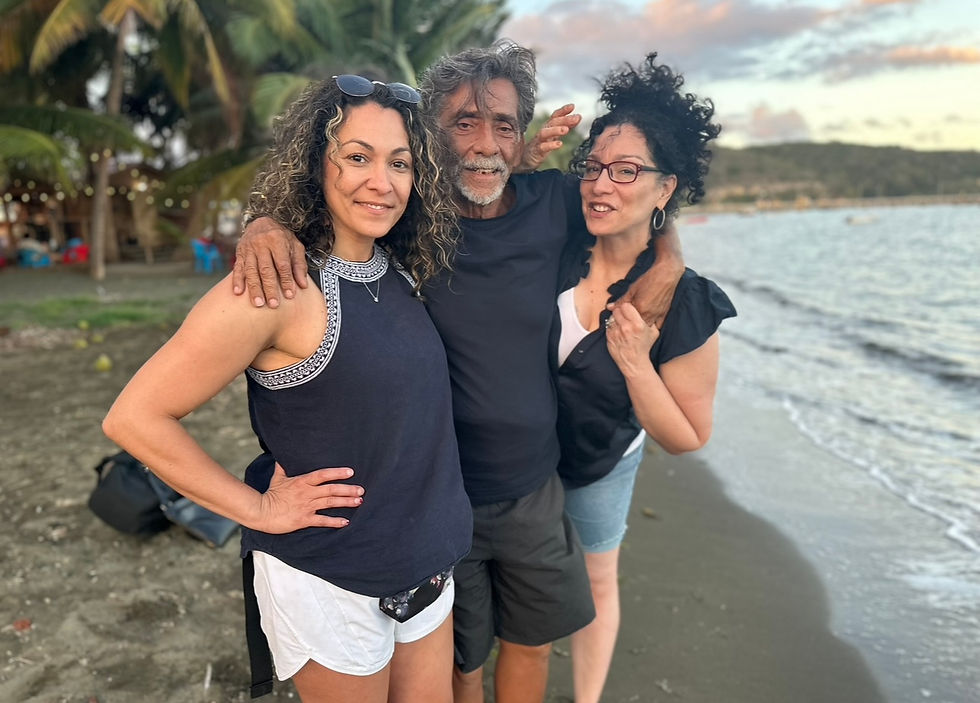
Fernando “Andy” Burgos is a big joker and a charmer with a huge heart. “The life of the party,” as his daughter, Madeline “Maddy” Bastida, tells it. He has always loved helping others and bringing people together. He never lets anyone feel alone or unsupported.
Andy was born in Puerto Rico and spent his childhood moving between Puerto Rico and New York City as his father found work in both places. He grew up alongside two sisters and two brothers, all close in age. Family was at the center of his childhood. He learned to cook alongside his father. He loved Puerto Rican food and culture and sharing both with those around him.
As a young adult, Andy joined Job Corps. He had always been interested in fixing things, and through the organization, he found work in New York City, where he eventually landed a job he loved as a superintendent of an apartment building.

“I always saw him working,” Maddy recalled. “This guy worked no matter what time of the day.”
His work was about more than keeping the building running. Andy was always helping someone.
“He was actually, like, a community builder,” Maddy said. “Now that I understand what that means, I saw him doing it.”
But Andy also knew how to have fun. Their home in Manhattan was often filled with family, music, dancing, food, and laughter.

When Maddy was around 14, her family moved to Puerto Rico so her dad could work for her grandfather’s diesel company. After growing up in Manhattan, the transition was difficult.
“I thought I was Puerto Rican, but I didn’t know I was really Puerto Rican until I moved to Puerto Rico,” Maddy said. “It was a culture shock.”
She found herself in a small town where everyone spoke Spanish and everything felt different. “It was hard for all of us.”
Throughout the transition, Andy remained deeply connected to his family and his community, and he continued to make time for the things he enjoyed.

As Maddy got older, some of her favorite memories with her dad involved him teaching her new things. He taught her how to fish and prepare seafood. He taught her how to drive, taking her to empty supermarket parking lots in Puerto Rico to practice. And he taught her how to swim, even though she was afraid of the water. He encouraged her to trust him and move a little farther each time.
“One step at a time,” he told her. “Little by little.”
Throughout Maddy’s life, when she faced problems she did not know how to solve, Andy would tell her the same thing: “Just take it one step at a time.”
After decades of working, Andy retired and bought a house in Guánica, Puerto Rico, near the beach.

He bought a boat. He fished. He talked with his neighbors. He enjoyed his life.

Maddy, who was building a life for herself in Washington state, visited him every year. For a while, everything seemed to be going well, but then she started to notice changes.
The first time was when Andy told her he did not want to come to her wedding. She took it personally, until it became evident that something was changing in him. He seemed more forgetful and generally less interested in his usual activities.
When Andy saw doctors in Puerto Rico, at the family’s suggestion, they explained that maybe he was dealing with depression, maybe a cognitive impairment of some kind. But they didn’t offer specifics, so Maddy and her sister continued trying to understand what was happening and how to help him.
At the same time, Maddy was working a corporate job full time in Washington and preparing to take her daughter to college. During one of her trips to Puerto Rico to support her dad, she had to miss her daughter’s 18th birthday.
“My daughter doesn’t understand, right? She’s a kid. She doesn’t get it. I’m her mom. She wants me to be with her,” Maddy said.
What made it harder was that Maddy did not know anyone else outside her family who was going through this.
“I really didn’t have anybody to talk to,” she said. “No one that I knew was going through what I was going through in my circle.”
Eventually, Maddy and her sister decided they needed to bring Andy to Washington.
It took a lot of careful coordination. Maddy handled the administrative work from Washington while her sister traveled to Puerto Rico. Their mother, long divorced from Andy, helped get him onto the plane because he trusted her and her presence helped him understand that he was traveling with family.
When Maddy returned from dropping her daughter off at college, Andy was waiting for her at home, as planned.
The next morning, he asked, “Hey, how did I get here?”
After further testing, Andy was diagnosed with Alzheimer’s disease.
Maddy had very little experience with dementia. She had heard of Alzheimer’s and knew that it involved memory loss, but it was not something her family had talked about seriously. Maddy remembered her grandfather joking about “not wanting to get that old timers stuff.”
Maddy wasn’t sure what to do. At first, she tried to explain the diagnosis to Andy. She told him why he had moved and why he was living with her. But she quickly realized that the explanations were making him more distressed.
“He would get upset, and he would try to wander out because he wanted to leave and escape.” Maddy felt, “I [wasn’t] making him feel safe,” so she decided to learn how to communicate with her dad differently.
Maddy was able to take four months off work, and she immersed herself in learning about Alzheimer’s and caregiving. She went to resource fairs and attended memory cafés, where she was often one of the only daughters in a room full of people caring for their spouses. She connected with other caregivers and the Alzheimer’s community.
Maddy had always been the kind of person who tried to figure things out herself. But caregiving forced her to start asking other people for help.
“Have you experienced this?” she would ask. “Do you know someone who can help? Is there another community I can talk to?”
She learned that connecting with people could help her find resources and figure out how to communicate with Andy.
She began focusing on the memories he still had access to. She asked about his parents, his childhood, and his family.
She also returned to the things that had always connected them: food, music, and culture.
If she was making a Puerto Rican dish, she could ask Andy about the ingredients. Music could change his mood.

Work had always been a big part of Andy’s life, and Maddy found ways for that to continue. If he wanted to help out, he could vacuum, wash dishes, measure the dog's food. She learned how to offer these activities as a way to encourage Andy to continue to take on the roles he always enjoyed.
“He’s still a man, he’s still my father,” she said. And he still wanted to be there for others.

At one memory café, Andy met a man whose back was hurting. When the man said he might need to go home, Andy took off his own back brace and gave it to him.
“My dad was like, ‘I got back problems too,’” Maddy recalled.

For Maddy, it was another reminder of something she had always known about her father.“No matter what you do, you always stay humble … You always stay kind.”
Even as Alzheimer’s changed the way Andy interacted with the world, his instinct to help others remained. Maddy began to see that her role was not always to do things for him, but to find ways for him to continue contributing.
When she was considering hiring someone to paint her fence, her husband suggested letting Andy do it instead.
At first, Maddy resisted. “I said, no, I’m not going to. I don’t even know how to handle him.”
But Andy wanted to help his daughter.
“Why are you hiring someone? I’m your dad. I can help you,” he told her. So they painted the fence together.
It took three weeks and multiple trips to Home Depot. Andy painted one panel at a time. He taught Maddy how to pull out nails and showed her how to do the work. They talked. They joked.
“I would have never had that experience with my dad,” Maddy said. “The stories we talked about, and the jokes we told … That’s where I really kind of got to know him, because we were out there for hours. It was me, my dad, and a fence.”

As Andy’s Alzheimer’s progressed, Maddy learned that she could not do everything herself.
When she first brought Andy to Washington, her instinct was to handle everything. She wanted to make sure he was safe and worried about what could happen if she was not constantly watching over him.
For a while, Maddy felt like she had lost her own identity. People would ask, “How’s your dad?” rather than asking how she was doing.
“I’m still a mom. I’m still a wife,” she said. “And I have to be there for myself and my daughter.”
The decision to move Andy to memory care was not easy. Maddy worried that she was failing him.
“I felt like I was a bad daughter,” she said.
After he moved, Maddy visited almost every other day. She soon realized she was getting burned out and began asking others for support, including her husband, sister and others in her community.
The support Maddy received from other caregivers made her want to give back herself. Today, she serves on the board of Alzheimer’s Association in Washington and spends time at her dad’s memory care facility, where she dances, draws, and paints with residents. She also talks with other caregivers and shares what she has learned.
Shortly after Andy’s Alzheimer’s diagnosis, Maddy asked him if she could record some of their interactions so she could use their experience to help people in similar situations. He agreed, as long as they were doing it to support others with memory changes and their communities.
“I just really want to help as many people as possible,” Maddy said. “If I can help one person feel seen or less alone, I’m going to help them.”
To see what Maddy and Andy share with their community, follow them on Instagram @andy.maddy.alz.


Comments